

Is GEO Just SEO With a New Name? An Honest Answer
Blog by Juuga Marketing, a Vancouver digital marketing agency since 2012 · 698 Seymour Street, Suite 315, Vancouver, BC · Last updated November, 2026 ·
When it comes to GEO vs SEO, the honest answer is that GEO isn’t a new name for SEO, and it isn’t a replacement either. Generative engine optimization is SEO fundamentals, structured so AI systems can find them, trust them and quote them. At Juuga Marketing, we help local businesses get those foundations right first, then package them for AI search, because the order you do things in decides whether the spend pays off.
If you run a small business, you’ve probably heard the pitch already. Your SEO is outdated, AI is answering your customers’ questions, and you need a GEO strategy yesterday. Here’s what has really changed, what hasn’t, and where we’d actually spend the money.
Not sure where your business stands?
Request a GEO visibility review from Juuga and we’ll show you which gaps to close first.
GEO vs SEO: How Do They Compare at a Glance?
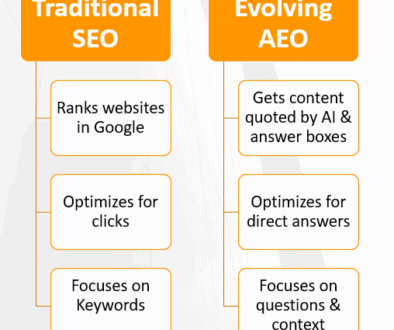
| SEO | GEO (generative engine optimization) | |
| Goal | Rank your page in search results | Get your business cited in AI-generated answers |
| What gets optimized | Whole pages | Passages, facts and entities |
| Key signals | Crawlability, links, content, reviews | All SEO signals, plus schema, entity consistency and off-site mentions |
| How success is measured | Rankings, clicks, organic traffic | AI citations and share of voice, alongside rankings |
| Where it shows up | Blue links, map pack, snippets | AI Overviews, ChatGPT, Perplexity, Gemini |
In short, GEO builds on SEO rather than replacing it. Most of the work overlaps, and the difference lies in how content is structured and how results are tracked.
What Actually Changed in AI Search Visibility?
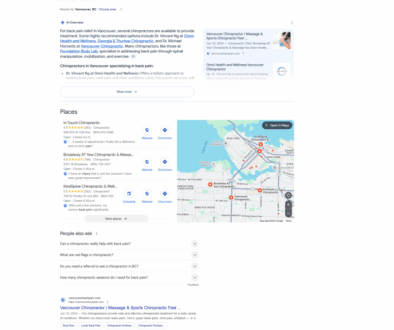
The shift is real and measurable. SparkToro’s 2026 study of US Google searches found that 68% of searches between January and April 2026 ended without a click to any website, up from roughly 60% in 2024. More people get their answer straight from the results page through AI Overviews, featured snippets, knowledge panels and map listings.
Two caveats belong next to that number. SparkToro switched data panels between its 2024 and 2026 studies, so part of the jump reflects a change in measurement. The study also points to AI Overviews as a likely cause but doesn’t isolate how much of the increase they drove. The direction is clear, but the exact size of the effect is still being worked out.
For a business owner, the takeaway is simple. Ranking well and getting clicks are no longer the same thing, so you can hold your spot on page one and still see fewer visits.
Is GEO Replacing SEO? What the Hype Skips
No. In that same SparkToro study, only 0.34% of US searches moved into Google’s AI Mode during the study period. AI Overviews are everywhere, but full conversational AI search is still a small slice of how people search.
Google is still where your customers look for a plumber, an accountant or a renovation contractor. A Vancouver homeowner searching for an emergency plumber in Burnaby or a North Shore renovation contractor still sees the map pack and organic listings first. And the AI answers they see are assembled from the open web: your website, your Google Business Profile, your reviews, directory listings and other places your business is mentioned.
That means a slow, thin, poorly indexed or inconsistent site can’t be cited by AI any more than it could be ranked by Google. There’s no GEO shortcut around weak foundations.
Which SEO Fundamentals Still Drive Generative Engine Optimization?
Most of what made SEO work still does the heavy lifting for AI search visibility:
- Crawlability and indexing. If search engines can’t access and understand a page, the AI systems built on top of them can’t either.
- Authority. Links and mentions from credible sources still signal that you’re worth trusting and worth quoting.
- Reviews and reputation. The volume, recency and substance of your reviews feed local results and AI summaries alike.
- Helpful content. Pages that clearly answer real customer questions have always performed well, and they’re exactly what AI systems look for.
- Accurate business information. Correct hours, service areas and contact details across your site and listings.
If your agency has been doing these things well, you already have most of a GEO strategy. If they haven’t, that’s the real problem, and a new acronym won’t fix it.
What’s Genuinely New in Generative Engine Optimization?
GEO isn’t pure rebranding, though. A few things matter much more now than they did three years ago:
- Structured data moves from bonus to requirement. Schema markup (Organization, LocalBusiness, Service, FAQ) tells machines clearly what your business is, what you offer and where. Search engines treated it as a nice-to-have, but AI systems lean on it to pull facts with confidence.
- Entity clarity. An AI system needs to be certain who you are before it recommends you. Describe your name, services, location and positioning the same way on your site, Google Business Profile, directories and social profiles, because inconsistency makes it more likely you’ll be left out of the answer.
- Answer-first content. AI tools pull passages, not pages. Content that states the answer in the first sentence or two is far easier to extract and cite.
- Being cited, not just ranked. Rank tracking shows where your link appears, not whether AI tools mention you when someone asks for a recommendation. AI answers change from one person and one prompt to the next, so there’s no fixed “position” to track. Regular spot-checks of your customers’ real questions give you a rough sense of whether you’re part of the answer, even if they can’t give you an exact number.
- Off-site mentions carry more weight. AI answers draw on reviews, community discussions, local media and industry directories, so what others say about you shapes what AI says about you.
How Does Juuga Approach GEO vs SEO?
At Juuga, we don’t treat GEO vs SEO as a choice. Our approach is built around doing both at once:
- Optimize for humans and machines. Every page has to persuade a real customer and be easy for an AI system to read, verify and quote.
- Show up in Google results and AI assistants. Your customers search both ways, so your business needs to appear in the map pack and organic listings as well as in ChatGPT, Perplexity and AI Overviews.
- Build pages and answer frameworks. We create the service pages people land on, and we structure them around the questions customers actually ask so AI tools can lift clear answers from them.
Our goal for every local client comes down to one line: don’t just be found, be the answer, locally.
How Does Juuga Sequence GEO vs SEO Work?
Our Applied Marketing© Framework is built on one principle: sequence matters. Each layer informs the next, and skipping ahead creates expensive problems. GEO built without SEO foundations doesn’t hold up.
Here’s how we sequence it:
- Foundations first. Technical site health, a complete and accurate Google Business Profile, a steady review program and clear core service pages.
- Structure for AI. Implement schema, align your business information everywhere it appears, and rewrite your most important pages so they lead with direct answers.
- Build trust beyond your website, and keep it current. Grow your reviews, earn mentions in local media, community groups and industry directories, and refresh key pages whenever your services, prices or customer questions change. AI tools tend to favour businesses that others talk about and whose facts stay up to date.
In the interest of transparency, when we ran a GEO visibility audit on our own site, the biggest gap wasn’t content. It was structured data. That’s a common pattern, and it’s usually one of the most fixable problems on the list.
We’re just as upfront about reporting. Most AI tools don’t share how often they mention a business, and zero-click searches mean visibility doesn’t always turn into a trackable visit. So we report on what can be verified, like rankings, Google Business Profile actions, leads and branded searches, and pair it with regular spot-checks of AI answers. We won’t promise you a precise “AI visibility score,” because no one can reliably measure one yet.
Want this sequence applied to your business? Talk to Juuga about SEO and GEO services and we’ll start with your foundations.
What Can You Do This Month to Improve Your AI Search Visibility?
You don’t need a new budget line to start. Begin with these three steps:
- Ask the questions your customers ask. Pick the five questions you hear most from prospects. Search them in Google, then ask them in ChatGPT or Perplexity and note who gets mentioned. It’s a snapshot rather than a measurement, but it gives you a useful picture of who you’re competing with in AI search.
- Audit your facts. Check that your business name, services, service areas, hours and contact details match across your website, Google Business Profile and major directories. Then check whether your site has schema markup at all.
- Rewrite three openings. Make sure the first two sentences of your three most important service pages directly answer the question a customer would ask about that service.
What makes the difference is how everything connects: your website, your Google Business Profile, your reviews, your listings and the way you talk about your business across every channel.
Our team brings those pieces together. We start with the real questions your Vancouver customers ask, make sure your business is described accurately and consistently everywhere it appears, and build pages around the experience and proof only you can offer. We ensure that each piece of work supports the next, so your marketing works as one system instead of a collection of separate tasks.
If you’d like a team that sees the full picture, talk to us about your SEO and GEO strategy.
GEO vs SEO FAQs: What Else Do Business Owners Ask Us?
What is the difference between GEO and SEO?
SEO helps your pages rank in search results so people click through to your site. GEO, or generative engine optimization, helps AI tools like ChatGPT, Perplexity and Google AI Overviews understand, trust and cite your business in their answers. GEO builds on SEO foundations rather than replacing them.
Do I need both GEO and SEO?
Both are necessary as AI answers are assembled from the same web signals SEO builds, including your website, Google Business Profile, reviews and directory listings. GEO without SEO foundations has little to work with, while SEO without GEO structure leaves your business harder for AI systems to quote.
How long does GEO take to show results?
Technical fixes like schema markup and consistent business information can be picked up once search engines recrawl your site. Being named in AI answers builds more gradually as reviews, mentions and answer-first content accumulate, so expect progress over months rather than weeks. Because AI visibility can’t be measured precisely, look for steady signals like more calls, more searches for your business name and new customers mentioning AI tools.
If fewer people click, how do I know GEO is working?
Look beyond website traffic. Zero-click searches mean people may see your business in an AI answer and then call, visit or search your name directly without ever landing on your site. Calls, Google Business Profile actions, branded searches, leads and asking customers how they found you together give a more honest picture than clicks alone.
How do I know if my business shows up in AI answers?
Ask ChatGPT, Perplexity and Google the five questions your customers ask most often, and note which businesses get named or cited. Repeat the check every month or two. AI answers vary between users and sessions, so look for patterns over time rather than reading too much into a single result.
What is the quickest GEO win for a small business?
Structured data is usually the most fixable gap. Adding Organization, LocalBusiness, Service and FAQ schema helps AI systems confirm who you are, what you offer and where you operate.
Sources
- SparkToro, “In 2026, Less than One Third of Google Searches Still Send a Click” (Similarweb clickstream data, US, January to April 2026): sparktoro.com
- Search Engine Land, “Google zero-click searches hit 68% in early 2026: Study”: searchengineland.com